It was late August 2023 when I stepped off a plane at Paris’s Charles de Gaulle airport and promptly thought, “Wtf did I just get myself into?”
I was starting my semester-long study abroad in Paris, and the perfect movie moment I had pictured back home in California was nowhere to be found — I was all alone in a sea of people, had the French proficiency of a 2-year-old, and didn’t know anyone in Western Europe.
To top it all off, I didn’t have a place to stay outside of a hostel with my traveling sister for 4 days, having delusionally thought I’d find something very easily once I arrived.
You could describe the situation as “a bit of a pickle”.
Yet what proceeded over the next 4 months turned out to be the most magical period of my life, filled with so much wonder, excitement, joy, and great memories that I made with countless friends and strangers.
To read more about my study abroad experiences, read Episodes 1 - 29 of Adventure with Dennis!
Me at Le Mont St. Michel, October 2023
If you’re anything like me (confused college student), you’ve been intrigued by the thought of studying abroad, or have at least thought about it, for quite some time. Something in the back of your mind tickles you, telling you that living somewhere new would be tremendous.
What would you do? Who would you meet? What would happen?
Who would you become?
These thoughts are all the different ways your mind is encouraging you to grow, and a great way to do so is by studying abroad. This was certainly the case for me — it will be for you, too!
“So, Dennis, what exactly is studying abroad?” - you right now, probably
What a wonderful question, dear reader!
Studying abroad is where for an academic term, you’re a student in another country. How tremendously exciting!
While studying abroad, you meet so many amazing people, experience so many new and exciting things, and have the opportunity to re-invent yourself somewhere far from home. My 4 months in Paris were a blast, and I look back on those times fondly. Paris is where I started my first blog (Adventure with Dennis!) and met some of my closest friends to this day.
Plus, the food was amazing!
There is nothing I could recommend more in college than studying abroad. Every single person I’ve spoken to about studying abroad seems to be on the same page — I’ve never met a person who studied abroad and regretted doing so, but I have met plenty of graduating college seniors whose biggest regret was not going. If you have even an inkling of desire, go!
Now that you’ve decided to study abroad, it’s time for you to apply for a program and go.
There are many different ways that you can study abroad, but my recommendation is to do so through your university’s established program (there are other, non-university-affiliated programs, such as Semester at Sea and CIEE). Most universities have partnerships with other universities across the world, so just google “[your university’s name] study abroad program” and you’ll be good to go. There’s also very likely to be a study abroad office on your campus!
For example, googling “Cal Poly Study Abroad” led me straight to their study abroad program page here. It’s that easy!
If you’re a University of California (UC) student, the program I recommend by FAR is the University of California Education Abroad Program (UCEAP), which is the program through which I studied in Paris. UCEAP is the UC-wide program for study abroad and has hundreds of partnerships with universities in dozens of countries, making it super easy to find and apply for a program you like.
Friendsgiving dinner in Paris, November 2023
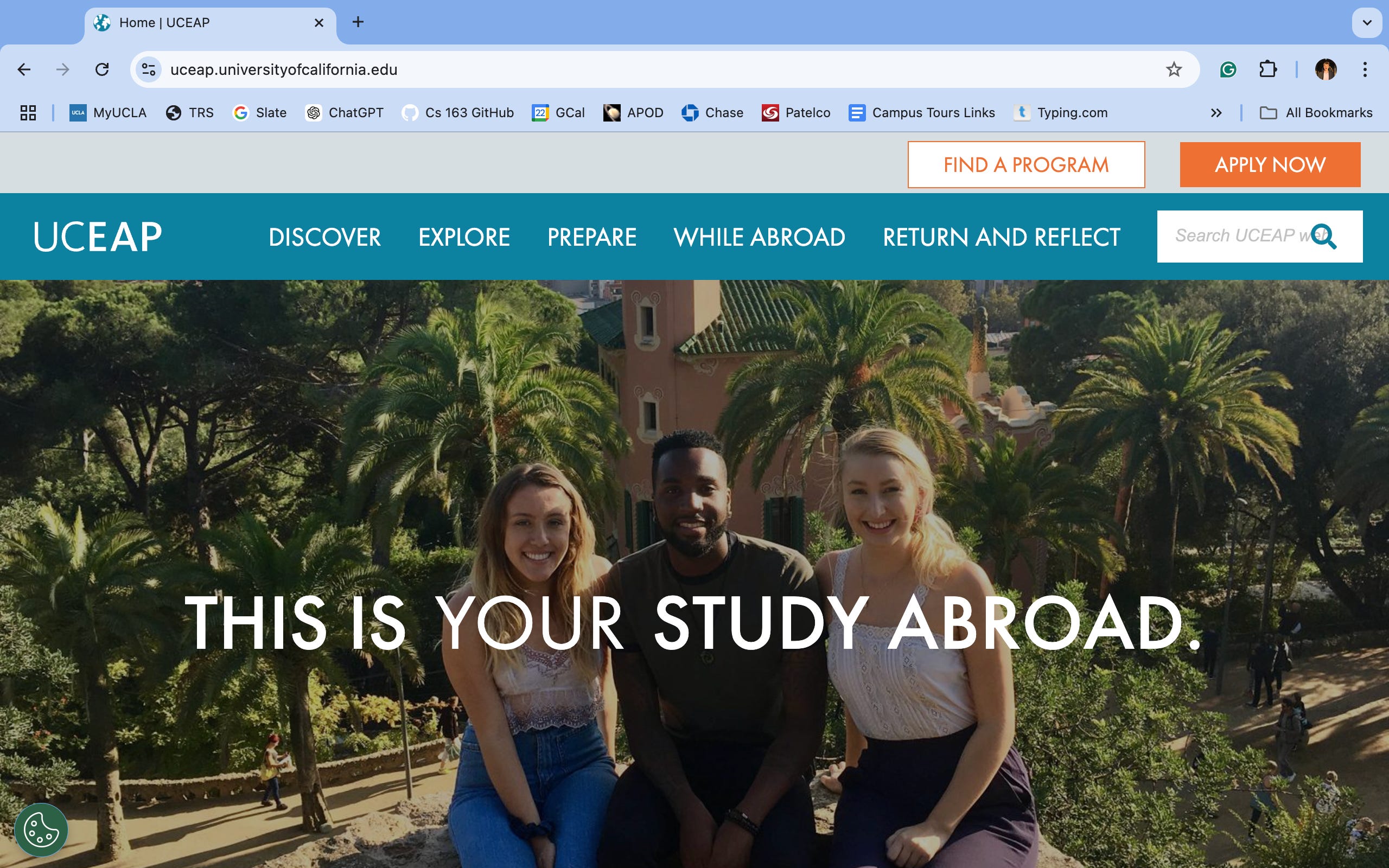
When you first open the UCEAP website, this is what you see:
UCEAP website landing page
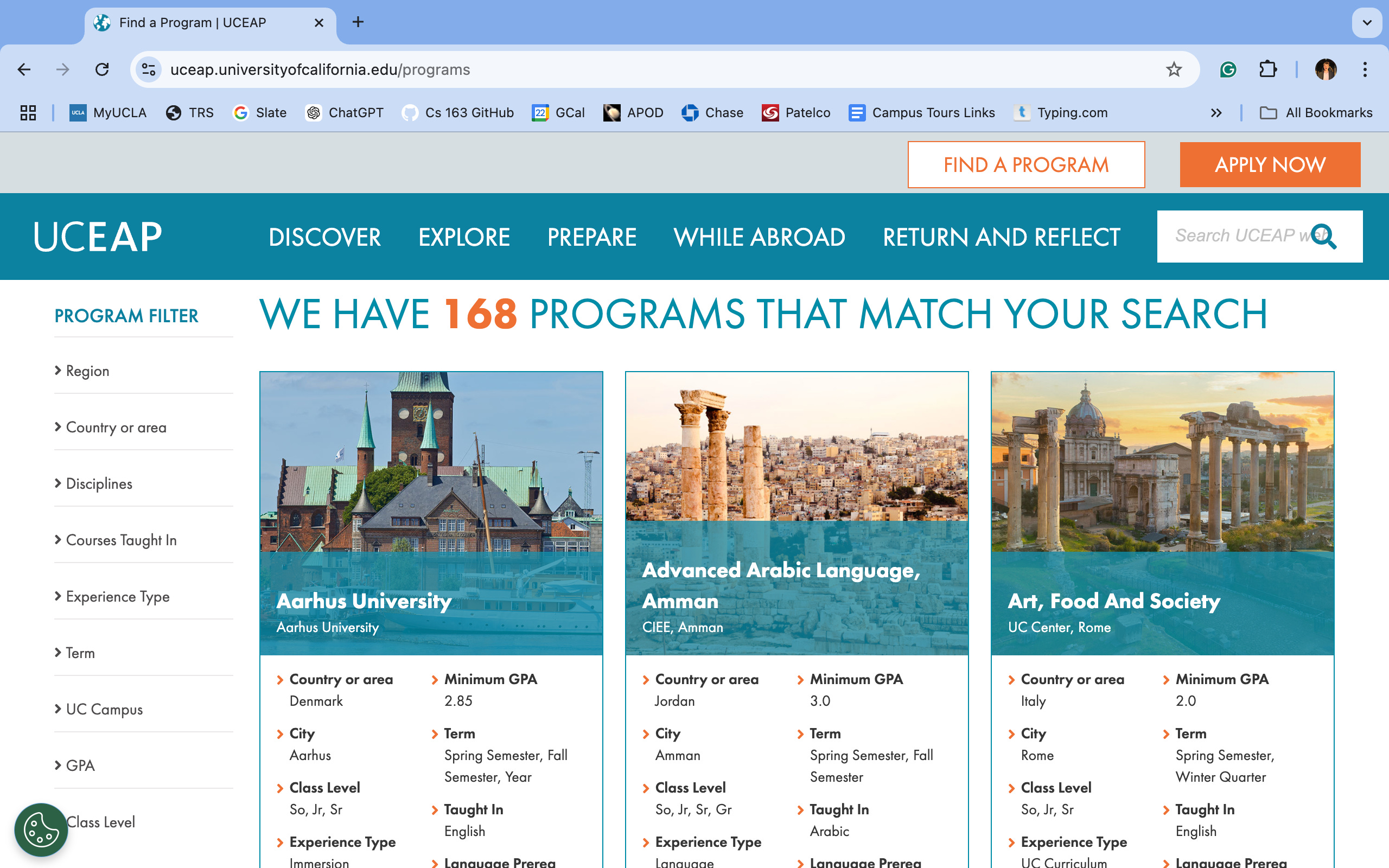
Go to the “Find a Program” tab at the top right (next to the “Apply Now” button) to see all the different programs to study. When you open the tab, you’ll notice right away that there are literally hundreds of options for where to go:
Quite overwhelming!
Fortunately, there are a bunch of criteria that you can filter by to help figure out where you might want to go. Some of you may know right away when and where you want to go — great! If that’s you, just go on down below to the application part of the article.
For those of you still unsure about where and when you’d want to go, filtering down your options is a great place to start.
Along the left side of the “Find a Program” screen (see above), we can see all these filters you can select:
Region (what major world region it’s in)
Country or Area
Disciplines (what areas of study the classes are for)
Courses Taught In (language of instruction)
Experience Type (how immersive the program is)
Term (what semester/quarter you’re going)
UC Campus
GPA (to toggle the minimum GPA needed to go, make sure you get good grades before you go abroad!)
Class Level (what year in school you are)
Most of these criteria are very important to consider, so let’s just go one by one and break down what you should be thinking about. For the full thought process about why I decided to study abroad in Paris specifically, check out my A Reflection on Study Abroad article!
Region:
From this article’s time of publishing, the different regions you can select under this filter are “The Americas”, “Europe”, “Africa & The Middle East”, and “Asia & Oceania”. If there is a particular region that you know you want to study in, this is where you can begin narrowing it down!
For me, this was Europe, because I had some crazy obsession with Europe at the time and really wanted to go. Maybe you know you want to go to Asia, but you’re just not sure where yet! Check the “Asia & Oceania” box, and you’re one step closer to finding out.
Country or Area:
This is the same exact thing as filtering by region, just much more granular by country-level. If you know exactly where you want to go, great! For example, my friend that was like “I’m going to London, I don’t care what university”.
I wasn’t too sure which country I wanted to go to in Europe, so I just left this one blank when I was deciding.
Disciplines:
Here, you can select your major course of study to filter away programs that don’t meet you academic needs. While studying abroad in Paris, I took five courses total: three economics courses, a history GE, and a French language course. The three economics courses transferred directly to UCLA as upper-division economics electives and the history GE carried over as a required GE at UCLA. The French class just gave me some extra units back home!
Going abroad can be a surprisingly great way to get a lot of your classes knocked out pretty easily. The UCLA Economics Department, for example, has detailed policies about transferring classes back to UCLA and an extremely helpful list of classes students have previously taken abroad that were approved for credit back at UCLA.
Side note: If you’re a UCLA student reading this, my advice is to save a few GE requirements for when you study abroad so you can take easy classes there! I took a French and British imperial history class in Paris, and it counted as a history GE back at UCLA. At the time of writing (Fall 2024), you’re allowed to transfer back up to 3 GEs for credit at UCLA. If you’re a UCLA Biz Econ/Econ student in particular, you can transfer up to 3 upper-division economics electives back to UCLA — that’s what I did! My advice there is to have completed micro- and macroeconomic theory (Econ 101 and 102) by the time you go abroad so that you’re guaranteed to have the necessary prereqs for any econ classes at your study abroad university.
If you’re not sure about taking courses for your major, I recommend saving up some GEs to take abroad. At UCLA, you’re allowed to transfer over 3 GEs from another university, so I made sure to save up some GE requirements before going to France. I know peers who took only GEs abroad and had so much more free time to travel and explore their new home.
Yay!
Courses Taught In:
This basically filters by what language courses at taught in. Most of these universities teach at least some of their courses in English, though many programs exist that exclusively teach in other languages. If you’re wanting a language-learning-intense program, these could be the ones for you!
For me, I made sure that the university I was studying abroad at taught courses in English. Sciences Po Paris taught them in both English and French, so I was all good there.
Experience Type:
The “experience type” section might be one of the most important criteria for you to consider where to study abroad. There are a few different kinds:
Immersion
International
Internship
Language
Multi-Site
Research
Themed
UC Curriculum
The biggest recommendation you’ll read in this entire article is to do an Immersion program. In Immersion programs, you’re actually enrolled in another university as an exchange student and have the opportunity to fully live as a student in another country.
While in Paris, I was enrolled as an exchange student at Sciences Po Paris — I had a student ID card (which was AMAZING because in Paris, university students get into any museum for free with their IDs! I literally would go to the Louvre for free between classes and skip the ticket line), took classes with French and other international students, tried out and made the volleyball team (somehow becoming a French collegiate athlete in the process lol), and rarely spoke to any other Americans.
I would personally advise against doing Internship or Research programs through study abroad. From the stories I’ve heard from people doing these programs, the internships and research projects aren’t that legit, and you have to spend a lot of money to do them.
The UC Curriculum programs are ones where UC professors come with UC students and teach their courses abroad. These can be cool, but you end up being abroad with other UC students anyway and your cultural immersion is limited. You meet less international students, and end up being sheltered from the experience of being a student at another university (since you’re still taking just UC classes with other UC students).
Many major cities also have “UC Centers” where these UC Curriculum programs take place and are home to the UC students studying there. These centers are, from my experience, simply little nuggets of America abroad. I visited the UC Paris Center once, where the first thing I saw was a girl telling her friend, “OMG I’m soooo excited to go out tonight" in the most basic white girl valley accent imaginable.
I immediately turned around, left, and never came back.
Go Immersion. It’s the best!
Term:
The term applies to when you’re going: fall, winter, spring, summer, or year. With term, there are a couple of important things to consider and pieces of advice I have to share.
Most universities are on the semester system, so it’s likely that you’ll be going abroad to a university like that, too. The options then go to fall and spring semester, and I strongly recommend going for the fall. In the fall, everyone is just starting out, everything is new for everyone, and you have the option to meet more people just starting out their exchange. Also, if you study abroad in the spring, you miss out on two quarters back at your quarter-system home university, making it quite hard to catch up academically. This isn’t a problem for the fall semester abroad programs, as you’d only be missing one quarter from your home university (if your home university is on the semester system, then there’s nothing to worry about here, go whichever semester you’d like!).
In terms of which year to go, I found that going during my junior (third) year was the best option for me. Going abroad during my second year seemed too early in my UCLA career (still setting up a home base), and I wanted to enjoy the full year of being a senior back at UCLA. So, it was during my junior fall that I went. Wouldn’t change a thing!
Summer is also a great option to go, but I do think there is something so special at being a student during the school year at another university. Students don’t study in the summer, and you’ll miss out on the true student experience if you go then. If it’s what works best for you though, go right ahead!
Once you filter down your program options, it’s very likely that there will still be a ton of options left for you to choose. Here, I recommend talking to your friends and family, chatting with other people that have studied abroad in certain locations, and just going with your gut. My gut told me that Paris would be more enjoyable than Germany for some reason (perhaps because I love the movie Ratatouille so much), and I had the most wonderful time in France. Ultimately, you’ll have an amazing experience wherever you go, and you have an entire lifetime to continue exploring the world!
The program applications usually open 8 months before the program starts (so for my Paris program starting in August 2023, I applied in early February 2023), and is pretty straightforward. You submit your college grades, passport information, and write a personal statement (you can read mine here). Nothing crazy at all!
You hear back in a few weeks (I’ve literally never heard of anyone getting rejected for study abroad), get your visa, and then you’re all good to go.
Adventure awaits!
Some last things before we part:
Unstable housing, or not knowing where you’ll be living, is one of the single most stressful things I’ve ever experienced. My biggest mistake when studying abroad was not securing housing in the new city before I arrived, and delusionally believing I’d figure it out quickly there. Before you go abroad, make sure you know where you’ll be living!
Studying abroad showed me the truth in the idea that bad things happen quickly, but good things happen slowly. There were plenty of “catastrophes” stressing me out in the beginning, but as I made friends over time in Paris, the experience became more and more magical.
I thought that when I went abroad, I’d become a completely new person, yet I ended up being very similar to who I was back in the US. Self-growth and discovery are something you must actively pursue and though being in a new location helps a ton, you still have to put in the hard work to find out who you are.
In the phrase “study abroad”, the emphasis is much more on “abroad” than on “study”. I took five classes at one of the top politics schools in Europe (Science Po), yet probably studied a total of 30 hours across all my classes to get at least A-’s in each course. lol
The most “basic” city to study abroad in is Madrid, closely followed by Barcelona. They’re great party cities with huge night life scenes, non-existent homework, and well-connected airports. You’ll also meet a bunch of other Americans studying abroad there, which I didn’t particularly want to happen to me.
And that’s all from me! Best of luck, and get out there into the world!
Best, Dennis
I really appreciate your feedback, so if you enjoyed this article, please let me know with a like or comment at the bottom of this page! If you have any question or comments (or want to chat about your study abroad decision), please reach out to dennis@interosity.co.