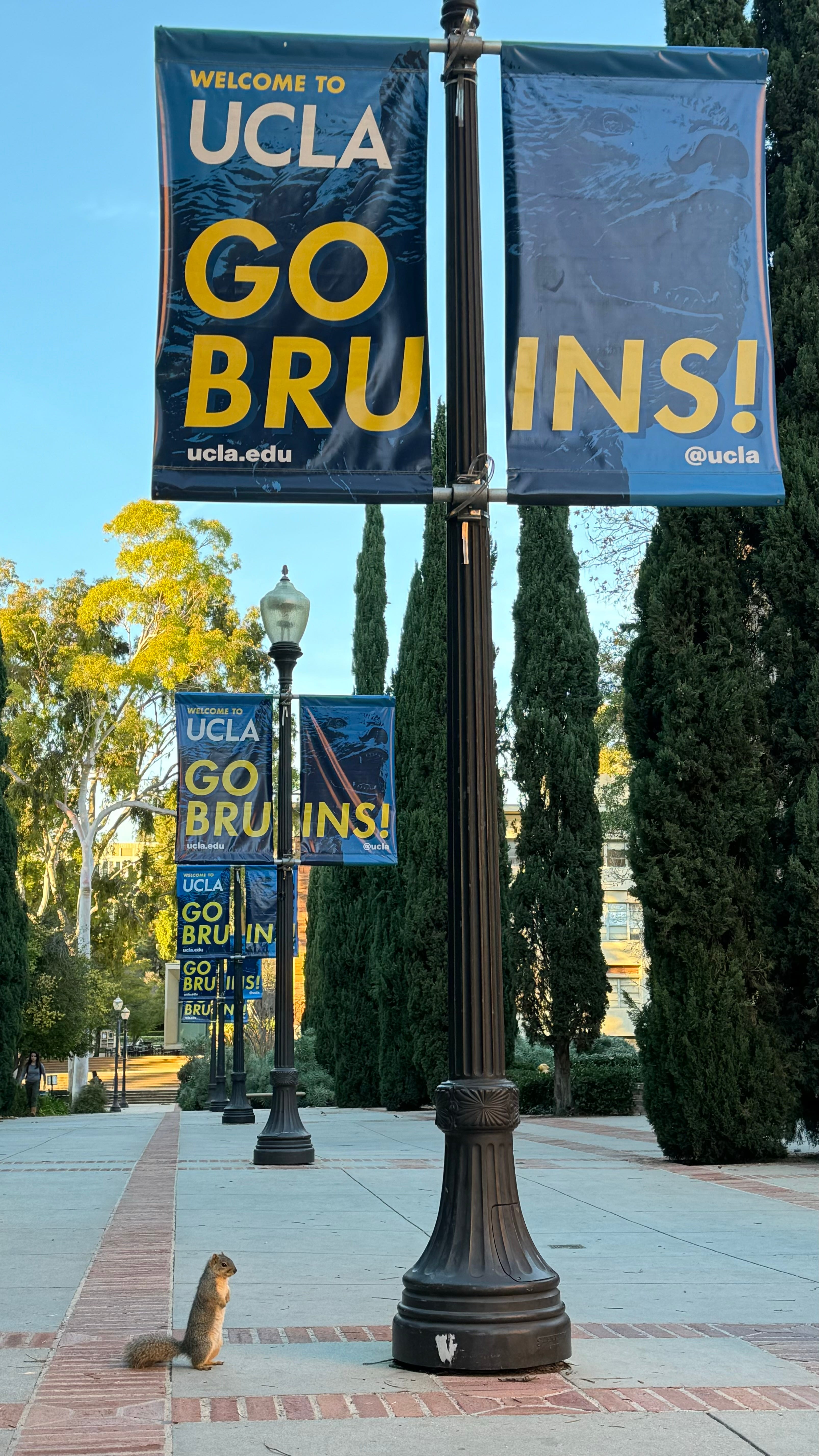
As I’ve been walking around UCLA the past few days, I can’t help but feel old when I see all the young, new faces on campus. I feel like I was just a freshman not too long ago, and here I am three years later, a senior already.
In the process of meeting and chatting with some of these new freshmen, I realized how much I’d grown and changed over these last three years. While I don’t seem to be too much different than the person I was yesterday, three years of accumulated growth has transformed me into a completely different person.
Chatting with these freshmen showed me just how much information, knowledge, and wisdom I had about college that I wanted to pass down — some things passed down to me from upperclassmen back in my day, others more random things I discovered along the way.
And so this article was born. It was modeled off this Jack Raines post about advice for a graduating college senior (go check it out, you won’t regret it!), and I hope it helps.
So what are we waiting for? Let’s go!
Is that a squirrel, or a Bruin?
The most important thing to realize about college is why someone goes to college in the first place. There are three main reasons:
To graduate with a degree to show companies you’re employable.
To meet people and make connections.
To have fun.
Let’s break it down.
The first goal of college (graduate with a degree to show companies you’re employable) is the most obvious of all — that is the fundamental reason you’re there. You show up, attend class, take exams, get good grades, get a GPA, apply to companies, get a job, then celebrate. A good amount of modern jobs require some sort of college degree, so just by going to college, you are checking off those boxes.
The value of the degree is twofold — one, you show companies that you can stick with something for four years (the length of a bachelor’s degree in the US) without quitting and while maintaining a high quality of output (reflected in a good GPA). And two, those classes you take theoretically teach you skills and knowledge that are useful in your future job.
However, considering that every Econ student at UCLA has wondered at some point in their undergraduate experience why they’re learning another useless model (and the fact that 90% of needed skills are learned on the job), the first reason is by far the more important one.
The other thing I’ll say about academics is to take advantage of all the random classes you can take. The favorite class of pretty much every college student (or alumni) I’ve ever met had nothing to do with their major but rather was some random elective they took and loved. Something like Roman Art and Archaeology (my personal favorite), History of the Beatles, Quantum Physics for Dummies, random things like that. Take those classes and go to those random events, because college is the best place to experience those kinds of things for free.
It’s also very possible that college will be the first time you struggle academically. If you’re attending a top-tier institution, it’s likely that for you to get there, you had a great high-school career. You were a stellar student, top athlete, popular, pretty, well-liked and well-known, all that.
When you come to UCLA, that all goes away since you’re surrounded by other students just like that. You are now part of the new normal. This will likely cause you to have an existential crisis at some point in time.
Know that that’s ok, and accept the fact that everyone is extremely motivated and talented (and that you’ll have an existential crisis). Having an existential crisis is almost a rite of passage for anyone starting college, and I strongly believe that never having one means you’re not challenging yourself enough.
At college, your classes will likely be harder, and you may be more stressed out about them. You may even fail your first exam, giving you an existential crisis.
Fortunately, personal experience has shown me that while failing your first exam feels like the end of the world, failing your second one feels much less catastrophic. Hooray! Survive one failed exam shows you that it really isn’t as bad as you thought it’d be, the grade can always recover, and your self-worth is still whole. Trust me :)
Another great part of college is all the amazing people you meet.
When you go to college, it’s often the first time you’ll be meeting a large amount of people who are very different from you in some fundamental way — they come from a different city, state, or country, they speak different languages, wear different clothes, speak differently, think differently, act differently.
Just different.
It’s crazy stuff. I remember I was blown away by the diversity of human experience and background at UCLA. The dorm complex was home to over 10,000 students, all living within a 5-minute walking distance of each other. That is insane! When else will you be living among such diversity in your life? During the process of meeting all these different people, you’ll be exposed to so many new ideas and backgrounds, which will very much challenge your worldview and ideas themselves.
This may also give you an existential crisis.
The other great thing about schools like UCLA is the sheer amount of resources and brilliance available to students. Take advantage of being a student and capitalize on all the free events your campus offers — professor talks, events, career fairs, etc. My advice is to explore as many of the buildings on campus as you can (walk through the hallways and different rooms) to discover the different departments and the events that are put on. Meet cool professors, attend random events, and explore campus as much as you can.
Last, but most certainly not least, have fun. This one is pretty self-explanatory.
This goal comes from the fact that in college, you are living within walking distance of thousands (if not tens of thousands) of other people that are your age who all have effectively zero real responsibilities. Friendships can be made in a day, you’re young and healthy, full of hopes and dreams, can join clubs and organizations for hobbies you didn’t even know existed, and there is an entire sports franchise that you can now cheer for wholeheartedly at hundreds of different games throughout the year (your college teams).
There’s a reason why almost every single college graduate says that college was the best four years of their life. It’s the very definition of having fun if I’ve ever heard of one.
Some of the best memories I had were of doing random things with friends, and those are the memories you’ll cherish the most. I’ve been on so many wonderful camping trips, excursions around LA and SoCal, but also around campus, too. Find the great study spots in the different buildings and libraries (they’re great date spots, too!). Have those random conversations with roommates and friends in the dorm room lounges, late-night roof escapades on campus, philosophical discussions about the meaning of life — these are the college experiences you’ll remember (convinced that I couldn’t break his metal baseball bat, my roommate Simon and I found ourselves at a local collection of boulders outside our dorm room at 1 am during our freshman year, where I promptly smashed the baseball bat in half).
Do the fun things, as they won’t be there forever.
Random other tidbits that don’t really fit in anywhere else:
These last little things are much more disjoint and didn’t fit in anywhere else, so I figured I’d just leave them all at the end here for you.
DO NOT get a boyfriend/girlfriend your first quarter/semester of college!!! This is the classic fatal freshman mistake since when you start dating, you want to spend all your time with that person (naturally). This severely detracts from your social development and friend-making elsewhere, and when you (almost) inevitably break up with your first college relationship, you’re left with no friends. I see this happen literally every single year
Your ultimate goal should be to try to be interesting. Of course, this looks different for everyone, but no one likes the cookie-cutter person who by trying to fit in everywhere, doesn’t seem to even be their own person. Please please please, don’t be a bot.
My go-to best first date was a late morning/early afternoon coffee in a nice, public area. It’s low stakes, not too long of a time commitment, either party can dip if needed, and it’s very low pressure. If you’re at UCLA, getting coffee at Kerckhoff Coffeehouse, then hanging out on Janss for a bit was my go-to.
Having a few, closer friends brings a lot more happiness and meaning than lots of shallow ones. In your first year, try to meet as many people as you can to see what’s out there, but eventually hone in our your core homies :)
Don’t add or subtract to the human population (translation: don’t be an idiot and get (someone) pregnant, or kill someone accidentally from an under-the-influence freak accident)
At a place like UCLA, opportunities will fall from the sky. Job opportunities, friends, mentors, potential partners, all these can come from anywhere and anytime, quicker and more unexpectedly than you could ever imagine. The key is to recognize when these opportunities present themselves and jump on them as soon as they arrive (I met my first college girlfriend when we were randomly assigned to the same case competition team. We got lunch after, hit it off, and started dating a month later).
As a UCLA student, you have a lot of freedom to ask stupid questions and reach out to some awesome people. Use the fact that you’re a college student to network your way in with some awesome people :)
So many things are random. Who you live with, who you date, who you befriend, who you interact with — at such a large and dynamic place as college, the people you interact with are chance occurrences that just so happened to occur to you. One of my closest friends (Ariv) and I met when he was walking behind me on the way to class, overheard me roasting my friend on the phone, and invited me to lunch when I hung up because he thought I was funny. We got lunch, and he’s one of my closest friends to this day.
Mandatory readings are rarely, in fact, mandatory.
Never buy textbooks and always opt-out of any “required” course materials to save yourself a ton of money. All of these materials can be found online at z-lib, Google (search “[textbook name] free pdf”), or your school library, all for free! I have literally never bought a college textbook and have opted-out of Inclusive Access ever single quarter.
Having an up-to-date calendar is a godsend (I love Google Calendar). If you’re a UCLA student, you can download your class calendar data under your Study List on myUCLA, and then color-code all your classes!
Read the book Excellent Sheep by William Deresiewicz. It gives a lot of amazing insights into how the mission of getting into a great college distracts you from the actual goals of college in the first place. I highly recommend reading it; the sooner in your college experience, the better.
If you’re a first- or second-year student, your #1 value-add to upperclassmen is your swipes. We LOVE the dining hall food (UCLA has #1 campus dining!!), so if you want to network or chat with upperclassmen, offer to swipe them for a meal. We’ll accept, every time!
Investing in an iPad and a good note-taking app (I recommend Goodnotes!) is the best advice I have academically. I remember walking into my first college lecture freshman year and being astounded that everyone was taking notes on an iPad (I was still using the caveman-era technology of a pencil and notebook). Once the notes, classes, and studying got crazy, my paper notes system was cooked and I fell so behind academically. I got an iPad, Goodnotes, and the rest is history. Do yourself a favor, and transition over as soon as you can!
And that’s all from me, folks! Enjoy the amazing experience of college, and don’t stress yourselves out too much. The days are long but the years are short, trust me. In no time at all, you’ll be in my shoes, graduating in under a year. Best of luck!