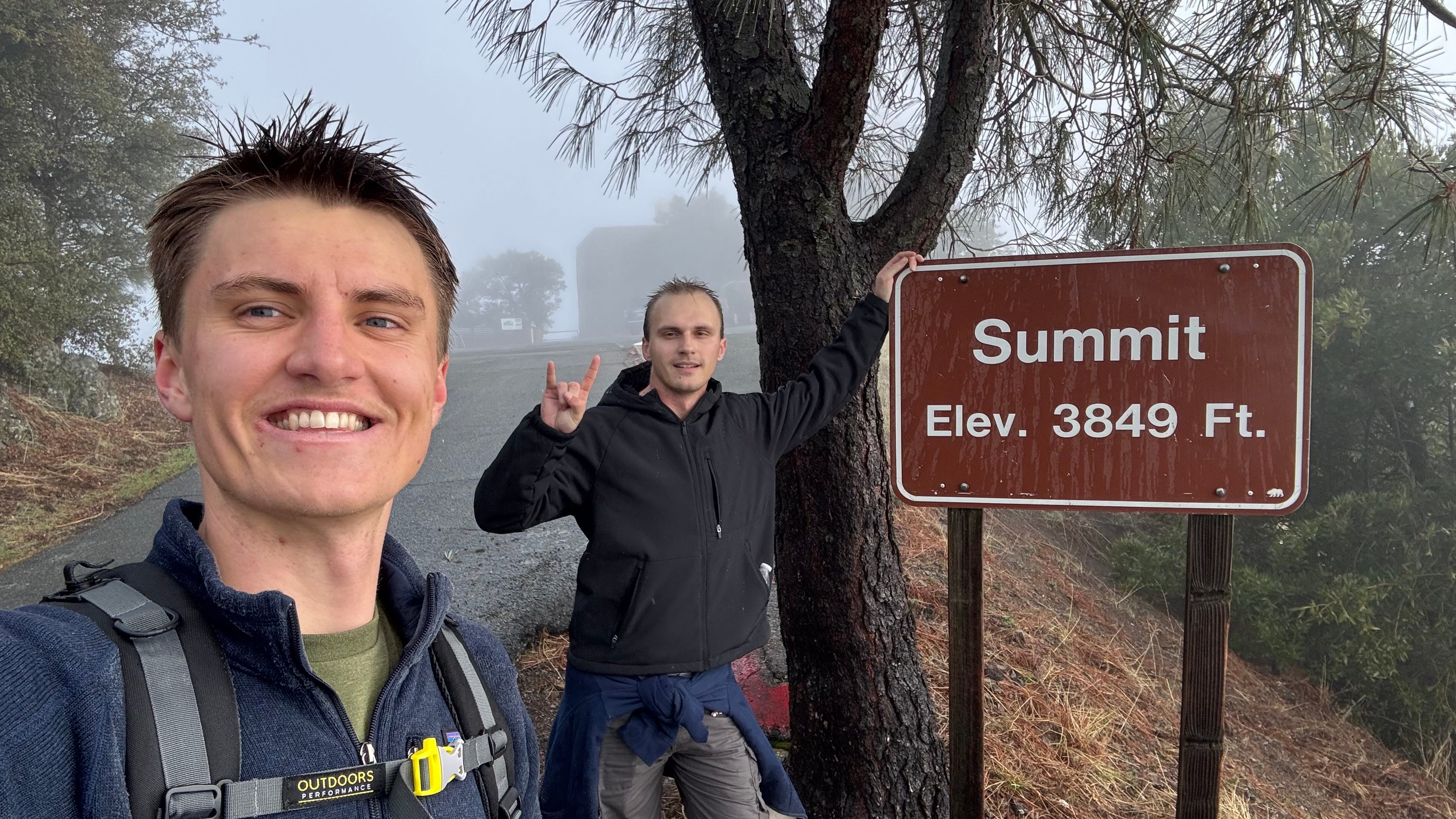
Over winter break, I went on a hike with my cousin Daniel up Mt. Diablo in the SF Bay Area.
Besides being a tremendous time, full of great views and stunning terrain, it was also a great chance for my cousin and I to catch up. Eventually, he started asking me some questions about the English language (he’s improving his level of fluency after moving to the US a few years ago), and we started discussing the specific differences between similarly meaning words.
I didn’t think much of it, until I realized that this stuff is actually extremely complex.
For example, what’s the difference between build, assemble, and construct? They’re all quite close to each, but they aren’t all pure synonyms. You could build a road, but you wouldn’t really assemble one. After some thought, I decided that building means creating something new, whereas assembling is building something with a finite set of pieces.
Like Legos, or Ikea furniture. You could assemble those!
And what about the context around when you’d use “almost”, “around”, and “about” regarding time? “It’s almost 2 pm” is slightly different to, “It’s about 2 pm”. One means that it’s before 2 and soon to be 2 pm; the other is an approximation of the fact that it is, roughly speaking, 2 pm.
And other various things like that.
This conversation with my cousin made me realize that languages are actually much more complex than we’d think, and that it’s honestly quite miraculous our brains can understand these things so quickly. As fluent speakers of a language, we know these contextual differences from a lifetime of practice, yet I never really appreciated how hard that was up this hike with my cousin.
It reminded me of when I first started learning French.
I was at the Alliance Française in Chicago in preparation for my upcoming study-abroad semester (Episodes 1-29) in Paris, and our instructor, Geoff (pronounced “Jeff”), was highlighting how strange languages can be.
He asked everyone in the room how they’d order a coffee at a café. Taking turns, my classmates and I shared our different ordering phrases:
“Coffee, please”
“Let me get a coffee”
“Can I have a coffee”
“I’d like a coffee”
“May I please get a coffee”
And so on.
As fluent speakers of English, we all understood that these phrases convey the same idea (a desire to order coffee), but they all use slightly different wording to do so. Someone who is just starting out learning a language may not know all these versions, and subsequently be confused when standing in line at the cafe.
So what was the point of all this? Was there some grand theme, major takeaway, monumental understanding of the universe achieved?
Not really. Maybe it’s that we should appreciate just how crazy cool our communication with each other is. Maybe I just thought it was tremendously interesting, and wanted to share it with you all.
Or maybe this is all just to tell you that you wouldn’t really assemble a road — you’d build it.
Best,
Dennis :)
My favorite linguistic blunder came from a conversation I had with a Parisian friend a few years ago. After asking them if they wanted to hang out later in the evening, they promptly replied, “Why would we go hang ourselves?”
Any linguistic blunders you’d like to share? Please comment them, I’d love to see!